

Orders of Growth, Keith Conrad
pdf 
Growth refers to **how fast a sequence of numbers increases**. Also important is the concept of a bound. **We say B bounds A** (above) **if B grows faster than A**, that is, at some point B becomes bigger than A and stays bigger forever (the same apply for bounded below). Linear, Polynomial, Exponential (and more) growth explained redit
The redit post lacks images. For that I've taken a screenshot from the pdf by Keith Conrad.
.
I was searching for a page that covered as many different orders as possible in one place. This one is pretty close.
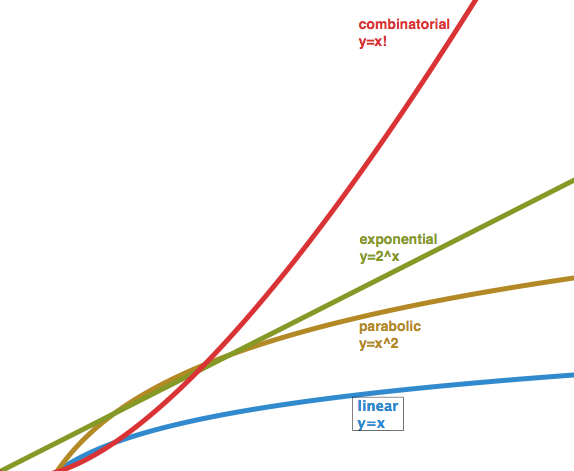
Log scale image of growth rates that exceed linear. source
Copyright 2018 Eric Dobbs. Licensed CC BY-SA 4.0
Ecological systems often display growth that follows a Logistic Curve
.
Systems with feedback loops often oscillate or exhibit some degree of chaotic behavior.
A transcendental function is an analytic function that does not satisfy a polynomial equation, in contrast to an algebraic function.
Examples of transcendental functions include the exponential function, the logarithm, and the trigonometric functions. wikipedia
Small differences in initial conditions, such as those due to rounding errors in numerical computation, yield widely diverging outcomes for dynamical systems, rendering long-term prediction of their behavior impossible in general. This happens even though these systems are deterministic, meaning that their future behavior is fully determined by their initial conditions, with no random elements involved. wikipedia

images