
I was staring into our yard, lost in thought, when a bumble bee entered my field of vision. I felt frustrated trying to follow the bee in its flight. I deliberately softened my focus and found my attention could follow the bee. I could, for lack of a better word, feel a visual sense of the winding movement through space.
To confirm my experiment I switched back and forth between intentionally using fovial and peripheral vision to track the bee. Only when I relaxed my eyes and let peripheral vision do the perception could my attention and my vision align. The emotional experience was consistent too: frustration when using fovial vision and feeling the misalignment between vision and attention; ease when using peripheral vision and feeling the alignment.
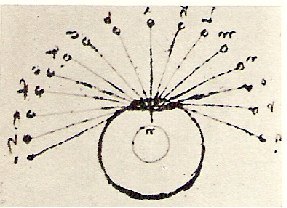
Human Eye with different lines. The line of sight (middle) is the only one permitting a view with good acuity.
Leonardo da Vinci, Public domain, via Wikimedia Commons jpg 
Fun fact. Leonardo da Vinci is believed to be the first to recognize the special optical qualities of the eye. His main experimental finding was that there is only a distinct and clear vision at the line of sight—the optical line that ends at the fovea. Although he did not use these words literally he actually is the originator of the modern distinction between foveal and peripheral vision. wikipedia 
Leonardo da Vinci, Public domain, via Wikimedia Commons jpg
.
See also Seeking Categories in the Brain.
See also Leonardo's Method.