
We compared David Woods' ten abstracted statements in the theory of Graceful Extensibility to the 73 indicators used to assess team fluency in the agile methods employed within the New Relic product group.
The opposite of brittleness in complex systems.
This required two levels of interpretation. First, what did we expect our indicators to indicate? Second, how did that indicated behavior align with that captured in Woods' proto-theorems? Given these two levels of judgement we sought out staff familiar with one or both of the systems and asked them to tally correspondence.
# Results
See Results by Theorem as assessed from different points of view within the product group.
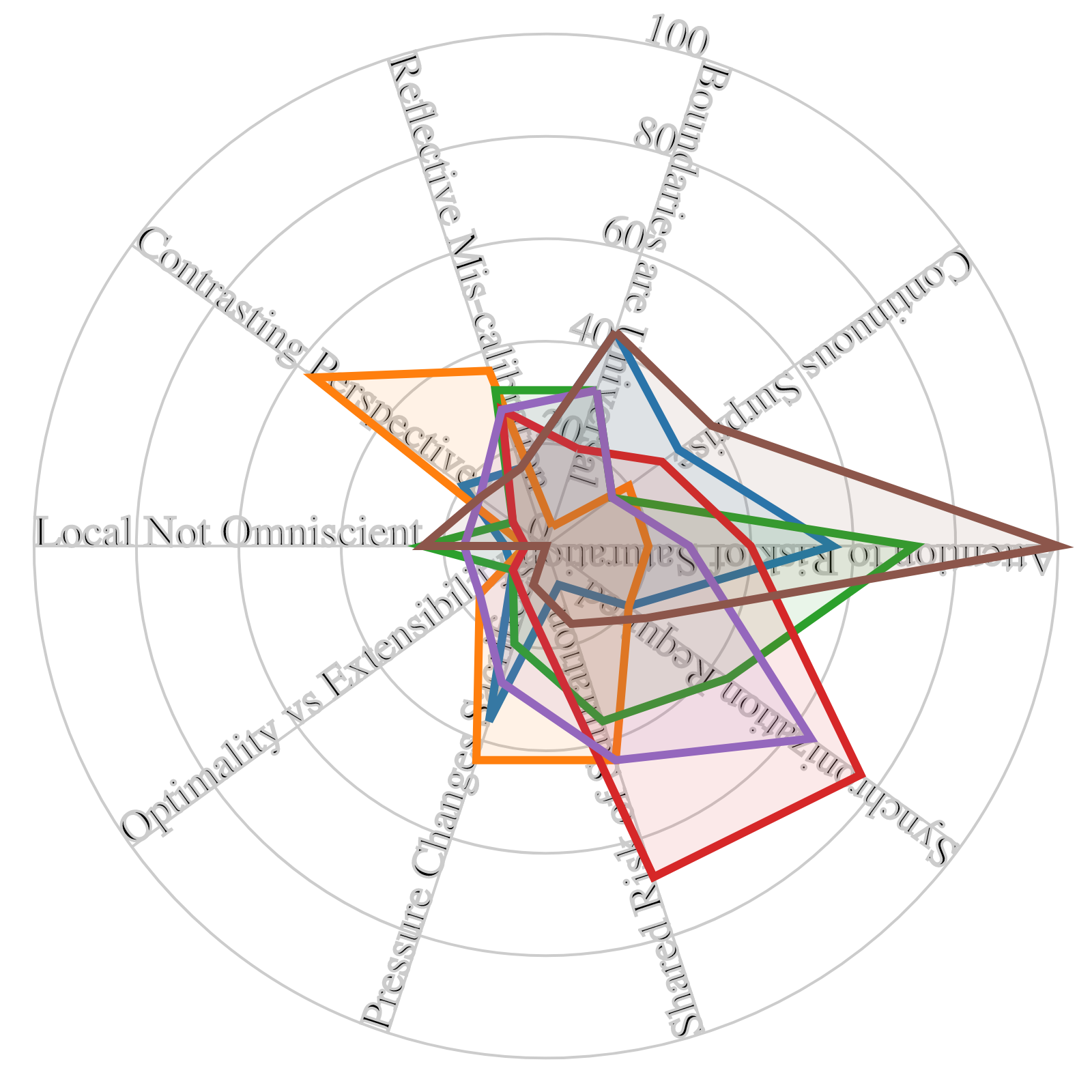 Radar chart. Ten spokes represent the ten statements. The distance from the center represents the percentage of New Relic team health indicators that were mapped to each statement. Six colored regions are overlayed in the chart. Each represents one assessment mapping indicators to statements.
At a glance we can see something like a Venn diagram of our mental models of team health and graceful extensibility. No surprise that we have different mental models. (See Line of Representation for another picture of differing mental models). Also no surprise that there's a fair amount of overlap in our assessments.
Our assessments all lean to the right. We've got an important blind spot. We are not measuring ourselves against the Outmaneuvering Constraints group of statements. In broad strokes, this group of statements concern how team responses to continual change and finite resources will support or inhibit each other's capacity for maneuver. We can either be cascading into brittle failures or gracefully extending ourselves to meet the challenges before us.